Journal Metrics
Manuscripts can be submitted via email to editor@jmils.com or jmils.editor@gmail.com
IF 2024: 1.9
MEiN: 100 pkt
ICI Journals Master List ICV : 121.13
H-index: 29
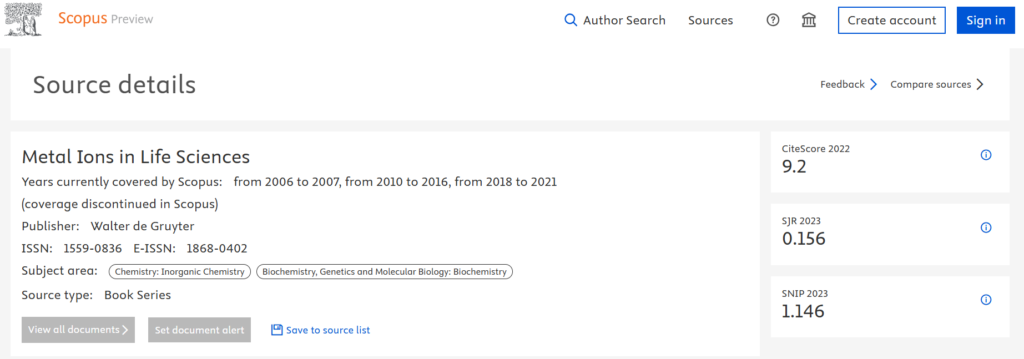
CiteScore : 9.2
SCImago Journal Rank (SJR) : 0.33
(SNIP): 0.555
Indexed/Tracked/Covered By: MedLine, PubMed, Scopus PubMed Central, CrossRef, EMBASE, BIOSIS Previews, Zoological Record, CAS, Google Scholar.
Accredited BY DHET, SOUTH AFRICA
Journal ID: JNL_014823
Metal Ions in Life Sciences is an international scholarly publication dedicated to advancing research at the intersection of bioinorganic chemistry, molecular biology, medicine, and life sciences. The journal provides a comprehensive platform for exploring the essential roles of metal ions in biological systems, human health, environmental processes, and biochemical mechanisms. The publication emphasizes the interdisciplinary nature of metal ion research and its impact on modern scientific discovery.
The journal publishes high-quality research articles, reviews, and thematic contributions covering diverse areas including metalloproteins, metal-based therapeutics, enzymology, coordination chemistry, toxicology, molecular and structural biology, environmental chemistry, pharmacology, and biomedical sciences. It aims to bridge fundamental chemistry with biological and medical applications, fostering collaboration among researchers from multiple scientific disciplines.
Since its establishment, Metal Ions in Life Sciences has served as an authoritative source for researchers, academicians, clinicians, and professionals interested in understanding the complex interactions between metal ions and living systems. The journal highlights both essential and toxic roles of metals in biological environments, including their significance in cellular regulation, disease mechanisms, diagnostics, and therapeutic innovation.
The journal welcomes contributions from researchers worldwide and maintains rigorous academic and ethical publishing standards. By promoting innovative and interdisciplinary investigations, Metal Ions in Life Sciences continues to support scientific progress in biological inorganic chemistry and related biomedical sciences.